
Ph.D. Candidate
Ohio State University
2020-Present

Research at
Advisors:
Laura Kubatko
Bryan Carstens
Species Distribution Modeling
We used species distribution models (SDMs) and GIS techniques to estimate the distance bat species migrate seasonally. We downloaded publicly available occurrence data, created cold season and warm season SDMS, and then calculated niche overlap metrics and the distance between centroids.


Comparative Phylogenetics
Morphological, behavioral, and life-history traits are important drivers of the ability of bats to forage, roost, and move around their landscape (and migrate). We used rigorous simulations to understand the nuances of the Phylogenetic Factor Analysis (PFA) method and then applied it to two groups of bats: the genus Myotis and the family Phyllostomidae to uncover latent structure in the multidimensional trait data.
Software Development - PICL
We (the Kubatko lab) are currently developing the software PICL (Phylogenetic Inference using Composite Likelihood), which takes an input of genetic data and efficiently processes it to return a proposed phylogenetic tree solution. We plan to officially launch PICL in summer 2026!

2017-2020

Research at
Advisor:
Joshua Reece
Master's Work: Ecological Impacts of Coastal Dredging in Morro Bay, CA
Our study site in Morro Bay, California has been a site of coastal dredging by the U.S. Army Corps of Engineers (USACE) since the 1960’s. The most recent major dredging event occurred in February of 2017. During this time, 240,000 cubic yards of sediment were dredged from the harbor and deposited onto the beach as beach nourishment. We assessed the impacts of this beach nourishment over two years on three aspects of beach ecosystems: 1) beach width, 2) avian biodiversity, and 3) intertidal macroinvertebrate biodiversity. Biodiversity was not significantly different at the dredge deposition site compared to the control sites, however, beach width was significantly wider at the deposition site.


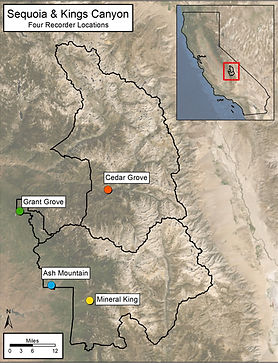
Long-Term Survey of Bat Biodiversity in Sequoia/Kings Canyon (SEKI) National Parks
SEKI is a set of jointly administered national parks located in the Sierra Nevada mountain range of California that span from lowland/foothill scrub habitat to high elevation, coniferous, and alpine habitats. In early 2019, we (a collaboration between NPS staff and the Reece Lab at Fresno State) deployed passive, continuous acoustic detectors at four sites, chosen to represent the geological, environmental, and fire history heterogeneity present in the parks. Along with downloading recordings each month, we also assisted NPS staff with monthly mist-netting and public "Bats and Scientists" night outreach programs. Seventeen species of bats have been detected in the parks using the automated bat call analysis software Sonobat. This work remains ongoing at Fresno State. Check out the Fresno State newsletter about it here.
Click to hear canyon bat call!
